Choosing the right page builder is one of the most important decisions you’ll make when creating a WordPress website. Your choice affects not only how your website looks but also how easy it is to manage, how fast it performs, and how effectively it helps your business grow.
If you’ve researched WordPress website design, you’ve probably come across two popular options: Elementor and Gutenberg. Both are powerful tools for building websites without extensive coding knowledge, but they serve different purposes and offer different experiences.
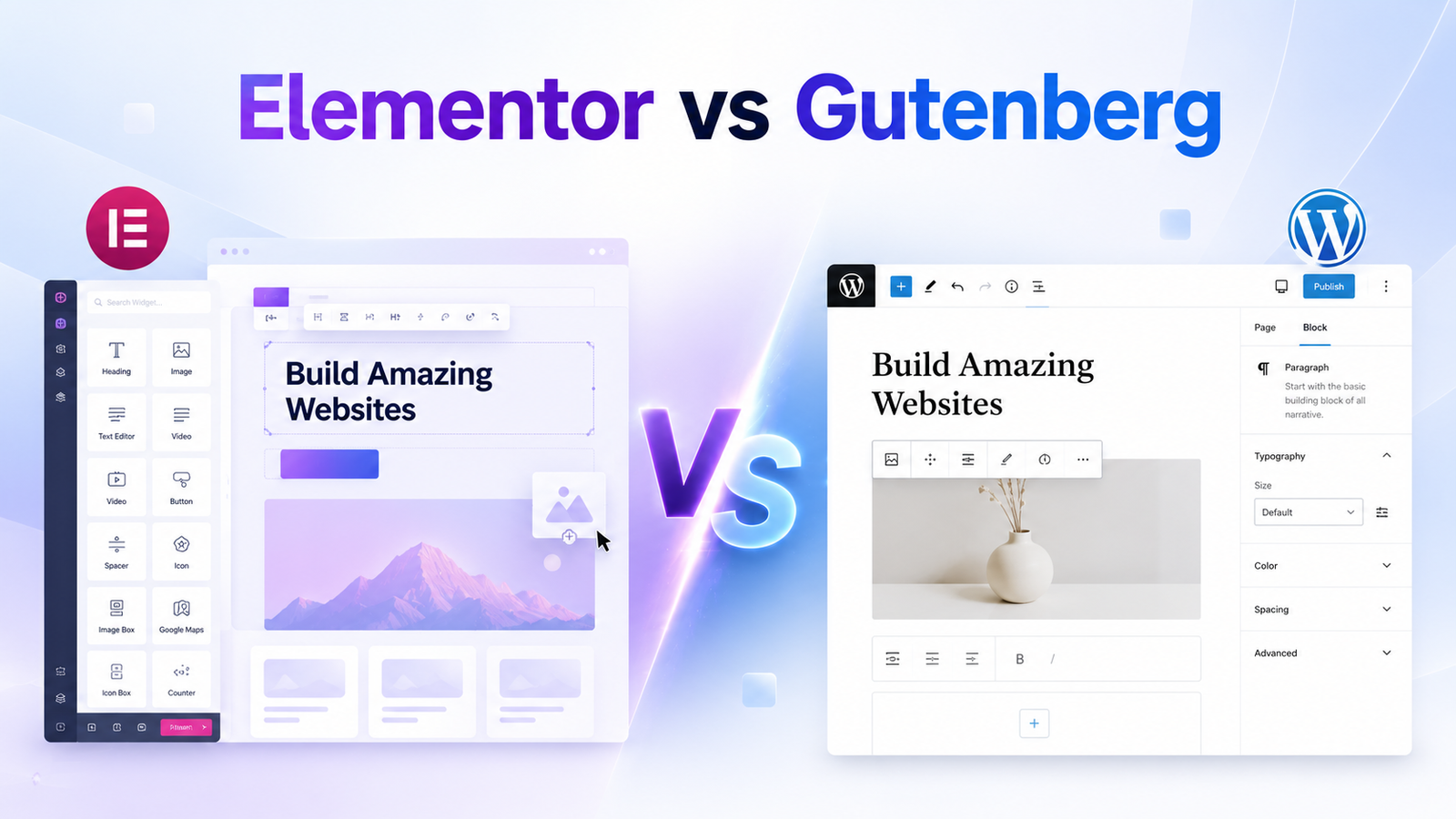
Gutenberg is the default WordPress block editor, designed for creating content using blocks. Elementor, on the other hand, is a powerful visual page builder that gives users complete creative control with drag-and-drop functionality, advanced design options, and hundreds of professional widgets.
So which one is better for your business website?
The answer depends on your goals, budget, technical skills, and the type of website you want to build. In this guide, we’ll compare Elementor and Gutenberg across every important aspect to help you make the right decision.
Understanding Gutenberg
Gutenberg is the default editor that comes built into WordPress. It replaces the classic editor by allowing users to build pages using individual content blocks such as headings, paragraphs, images, buttons, galleries, videos, and columns.
Its primary goal is to simplify content creation while keeping websites lightweight and fast. Since Gutenberg is developed by the WordPress core team, it integrates seamlessly with WordPress updates and requires no additional installation.
For bloggers and simple business websites, Gutenberg provides a clean editing experience without unnecessary complexity.
Understanding Elementor
Elementor is one of the world’s most popular WordPress page builders. It allows users to design complete websites visually using drag-and-drop editing.
Unlike Gutenberg, Elementor focuses heavily on design flexibility. Users can create fully customized layouts, landing pages, business websites, portfolios, WooCommerce stores, and marketing pages without writing code.
Elementor includes hundreds of widgets, templates, animations, responsive controls, theme building features, popup builders, forms, and WooCommerce customization options.
For businesses that prioritize professional design and conversions, Elementor has become the industry standard.
Ease of Use
When comparing usability, both tools are beginner-friendly, but they offer different experiences.
Gutenberg follows a simple block-based editing system. If you’re writing articles or creating basic pages, it’s easy to learn. The interface is minimal and focuses mainly on content rather than design.
Elementor provides a true visual editing experience. Every change appears instantly on the page exactly as visitors will see it. You can drag elements anywhere, adjust spacing visually, customize typography, add animations, and build complex layouts without touching code.
For business owners who want complete creative freedom, Elementor offers a much more intuitive workflow.
Design Flexibility
This is where Elementor clearly stands out.
Gutenberg provides essential layout controls and block customization, but creating unique or premium-looking designs often requires additional plugins or custom CSS.
Elementor gives you complete control over every design element. You can customize colors, fonts, spacing, borders, shadows, gradients, backgrounds, responsive layouts, motion effects, and global design settings.
You can even build custom headers, footers, blog templates, archive pages, WooCommerce product pages, and dynamic layouts.
If your goal is to create a premium, modern, and visually impressive website, Elementor offers significantly more design freedom.
Website Performance
Performance is one of the biggest discussions when comparing these two builders.
Since Gutenberg is built directly into WordPress, it generally produces lighter code and can achieve excellent loading speeds with proper optimization.
Elementor adds additional CSS and JavaScript files to support its advanced features. However, modern versions of Elementor have introduced major performance improvements, including optimized asset loading, improved DOM output, lazy loading, and container-based layouts.
When paired with quality hosting, caching, image optimization, and performance best practices, Elementor websites can still achieve outstanding Core Web Vitals scores.
The final performance depends more on proper optimization than on the page builder itself.
Responsive Design
Modern websites must work perfectly across desktops, tablets, and smartphones.
Gutenberg provides responsive layouts through your WordPress theme, but customization options remain relatively limited.
Elementor allows complete control over responsive design. You can customize spacing, typography, visibility, alignment, margins, and layouts separately for desktop, tablet, and mobile devices.
This makes it much easier to deliver an excellent user experience across every screen size.
Templates and Pre-built Designs
Creating pages from scratch takes time.
Elementor includes hundreds of professionally designed templates, landing pages, section blocks, popups, and website kits that can dramatically speed up development.
Many businesses can launch beautiful websites within days instead of weeks simply by customizing existing templates.
Gutenberg offers reusable blocks and patterns, but its template ecosystem remains smaller compared to Elementor.
For agencies, freelancers, and businesses looking to accelerate development, Elementor offers a significant advantage.
WooCommerce Integration
If you’re planning to sell products online, choosing the right builder becomes even more important.
Elementor Pro provides powerful WooCommerce Builder features that allow you to customize product pages, shop archives, checkout layouts, and customer account pages visually.
You can design unique shopping experiences that match your brand without modifying theme files.
While Gutenberg supports WooCommerce blocks, customization options are much more limited unless additional plugins are installed.
SEO Considerations
Many people believe page builders negatively affect SEO, but that’s only partially true.
Search engines primarily evaluate website quality, loading speed, mobile usability, content structure, internal linking, and user experience.
Both Elementor and Gutenberg can perform well in search results when websites follow SEO best practices.
Using optimized images, clean heading structures, fast hosting, schema markup, proper metadata, and quality content matters far more than simply choosing one editor over another.
Cost Comparison
Gutenberg is completely free because it’s built into WordPress.
Elementor offers both a free version and a Pro version with advanced features such as Theme Builder, Popup Builder, Forms, Dynamic Content, WooCommerce Builder, Global Widgets, and Premium Templates.
For personal blogs or simple websites, Gutenberg may be enough.
For businesses that need advanced functionality, premium design, and higher conversion rates, Elementor Pro is often worth the investment.
Which One Should You Choose?
Choose Gutenberg if you:
- Need a simple blog or basic business website.
- Prioritize lightweight performance.
- Prefer using native WordPress features.
- Have minimal design requirements.
Choose Elementor if you:
- Want a premium-looking business website.
- Need complete design flexibility.
- Build landing pages or marketing websites.
- Want advanced animations and interactive layouts.
- Need WooCommerce customization.
- Plan to scale your website as your business grows.
- Want to manage your website visually without coding.
Final Verdict
Both Elementor and Gutenberg are excellent tools, but they are designed for different purposes.
Gutenberg is perfect for users who prioritize simplicity, speed, and content creation.
Elementor is the ideal choice for businesses, freelancers, agencies, and entrepreneurs who want complete creative control, professional designs, better user experiences, and websites that generate leads and sales.
If your website is one of your most important business assets, investing in Elementor can provide greater flexibility, stronger branding, and better long-term value.
Ultimately, the best choice depends on your business goals. However, if your objective is to build a premium, conversion-focused, SEO-friendly website that stands out from competitors, Elementor remains one of the most powerful website-building solutions available for WordPress today.